Tune in every Tuesday at 10:00 am central time for a tip from Gretchen Fleener of Paintertainment.com! Our tips are geared mainly towards face painters, though may be applicable to other forms of artistic entertainment as well! This week’s tip is on the subject of brush tubs! Gretchen shows you what she uses for a more compact brush tub, and a little trick to add back those scrubby ridges in the bottom of the tub to get your bristles clean!
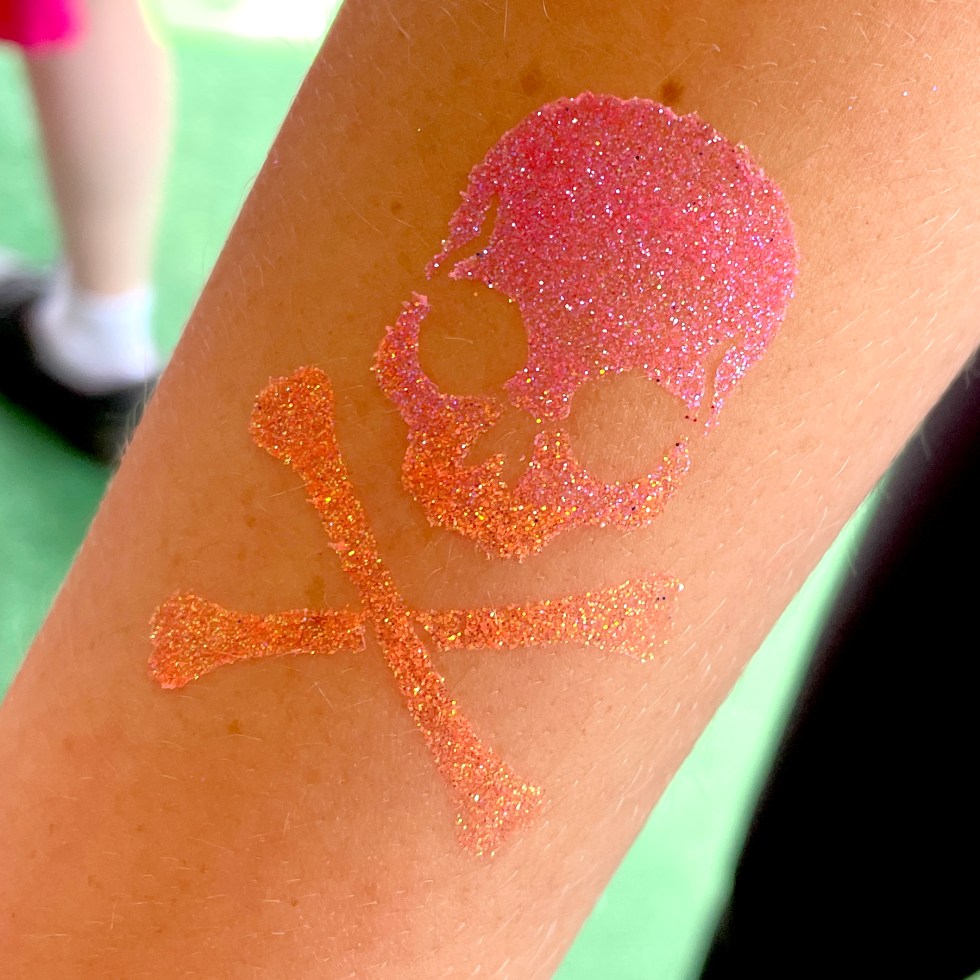
This past summer while working in my Glitter Glamper booth at the MN State Fair, I found myself not particularly loving my yellow, pink, and sometimes orange in glitter tattoos. The problem was that the kids saw my super bright looking “hot pink” glitter in my kit and always chose it, but it just didn’t come across as bright on the skin. I mean, you know how it goes…the kids still LOVE them, but we as artists are always our own worst critics, and we want our work to really pop. While it does depend a lot on the skin tone that they are being applied to, generally bright, bold and opaque colors just tend to show up better on glitter tattoos. Here are a few from the fair that showed my pink, yellow and orange woes…
I tried mixing in some orange with the yellow to capture the layering on Belle’s dress…meh…
This girl really wanted this pink and this orange…she loved it but to me it didn’t come across as bright as the jars of glitter may have led her to believe.
You can see how crisp and bold the dark green is…but as you get to the yellow flame tips, it starts to lose it’s readability a bit.
I found that I was not the only one in my booth having this struggle! But the awesome thing about working alongside so many painty friends is that you can learn from each other, share and test out other brands, and get better!
Well, now that the fair is over, I thought I would do a little experimenting with some different shades and brands of yellows, oranges and pinks…the three colors that seemed to disappoint me most! I should note, I am sharing this information simply to help my fellow artists. I don’t even sell most of these glitters in my shop yet…so it’s not a sales pitch and nobody paid me to do this. 😉 I tend to stock my whole store based on my own experiences and recommendations from painty friends, so I’ll likely be adding more of these down the road as I test them and fall in love with some!
Anyway, here are some photos of swatches on my own arm, along with some gif’s to show the sparkle factor!
Pink Glitters
I had the most shades of pink to test! The one I currently have in my kit is Amerikan Body Art’s Bubblegum Pink. It’s one that looks super bright, but when used as a glitter tattoo, isn’t quite so much. I do still LOVE this pink, and it is my go-to pink for face painting. It does tend to be a little bit more transparent which is why I think it doesn’t pop as much on plain skin. Over pink face paint though, it’s awesome and it’s sheer-ness means it won’t totally cover up my work but enhances it.
For glitter tattoos, however, I think the UV and Neon shades seemed to show the most contrast against the skin. So, if you’re going for that as your goal, I’d recommend the UV and Neon options. I’ve included some other shades of pink too, because you don’t always necessarily want the UV look, and there are applications for both. I also think that the non-neon versions do have more sparkle in the light!
Yellow Glitters
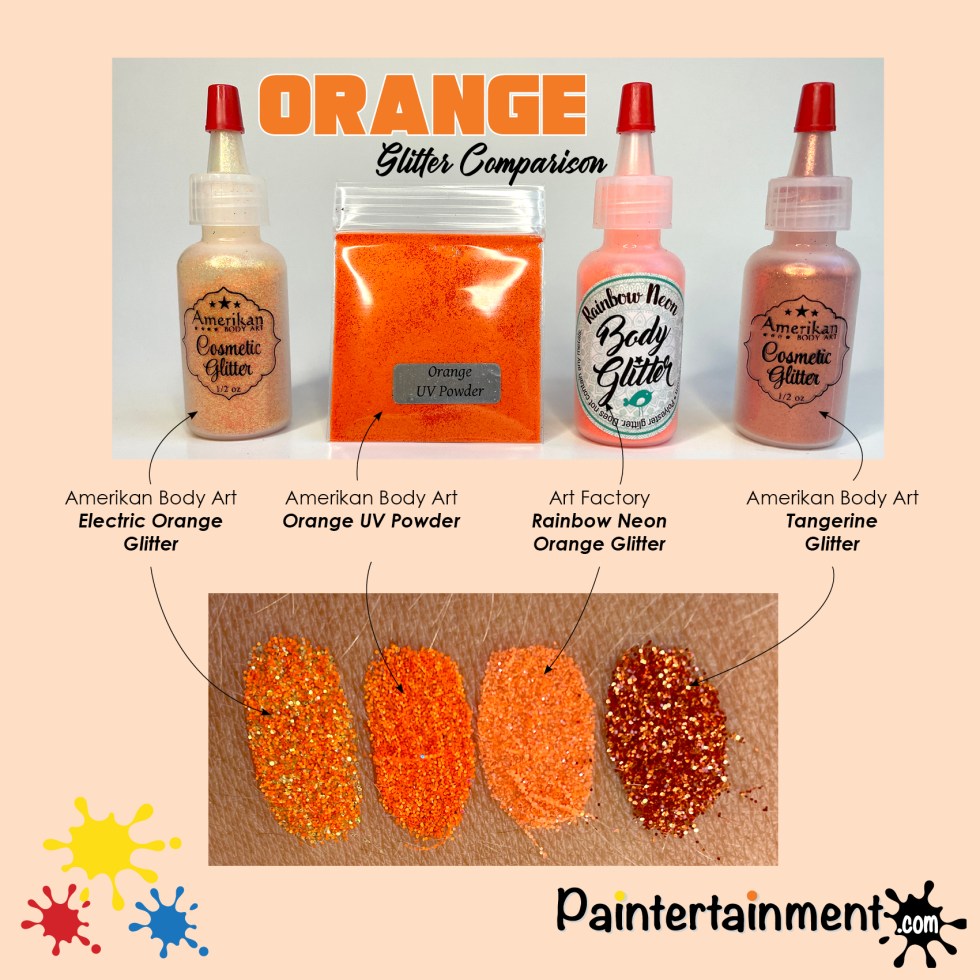
Same goes for the yellows, and the oranges below for that matter. The UV/Neon versions seem to be a lot more opaque and bold, though the more sheer, iridescent colors have more sparkle to them. I had been using Amerikan Body Art’s Lemon Zest…much like the bubblegum pink, I still think it’s the best for face painting, where the neon/uv versions are more bold and high contrast for glitter tattoos. The powders are less glittery, but I thought were worth a try in this comparison!
Orange Glitters
Electric Orange is my fave for face painting, again, though the UV/Neon options seem more opaque. I do like Amerikan Body Art’s Tangerine glitter too, for a darker orange!
Summary…
This is by NO MEANS an exhaustive sampling of these colors. I chose some from my existing vendors, some that looked good to me online, some that I found my fellow artists using, and some that I already had on hand. But what I’ve learned is that the more holographic glitters are best when poofed over face paint of a similar color, though the UV/Neon versions seem to be more bold and opaque when applied directly over bare skin, as we do for glitter tattoos. Neon glitters and powders are bolder, though the non-neon ones tend to have more sparkle.
Do with this information whatever you wish! For me, this has pretty much just made my kit grow, haha! I love both the more iridescent and the more opaque glitters and will keep both in my kit…just as I have both glycerine based and wax based blacks and whites in my face paint kit! They both have their ideal application.
Do you have a favorite shade of yellow, orange or pink that isn’t listed here? I’d LOVE to hear about it!!
Post it in the comments! I really prefer my blog posts to be living documents where we can all share ideas and new things as new things come along. We all know there’s a new product practically every week in our world, ha! Your comments help keep these posts relevant, so please feel free to share! Challenge my opinions and post your own! Thanks so much for stopping by and I hope this post has helped you in your own quest for the perfect glitter for your application!
So, we know that neon/fluorescent/uv makeup colors glow under black light. But many people have trouble figuring out the difference between terminology and just how to determine if something they are buying will actually glow under black light. The face and body painting industry uses all sorts of terms for products that really have a lot of artists confused. Split cakes, rainbow cakes, one-stroke cakes…what’s the difference? Just another example we’ll cover that another time! But it’s the same in the neon paint category! So this is my attempt to explain things!
What is the difference between Neon, UV, Day Glow, Fluorescent…??
Most people use these terms simply as a way to say they are “super bright colors.”If you want to make sure a product glows under a black light, the only question you need to ask is if the product itself reacts to UV light (like a black light) by fluorescing phosphors. Or in other words, “does it fluoresce under black light?” A paint labeled with any of these terms doesn’t necessarily mean it reacts to UV light. I mean, usually it does in the face and body painting world, but not all products, colors, and industries use these words the same. So if you are doing a gig where your paints must glow under black light, make sure to ask the right questions before making a purchase.
Let’s start with a mini lesson in the source of these terms…lights!
Neon Light
Neon is what you see in signage like the “open” sign above. They are made of long tubes that are bent into whatever shapes or letters are needed for the sign. These tubes emit actual colored light. Inside the tube is a low pressure gas. When a high voltage of electricity is run through the electrodes at each end of the tube, the gas “ionizes,” and the electrons get all excited, in turn freaking out the atoms which emit colored light. The gasses inside the tube vary, since each gas emits a different color light. Neon, for example, emits red light. Argon creates an electric blue-green color, and so on. The light itself is colored!
Fluorescent Light
Fluorescent lights are similar to neon lights in that they have a tube filled with gas with electrodes on each end. However, fluorescent lights have a mercury vapor inside, that emits UV (ultraviolet) light when ionized, instead of the colored light that neon lights emit. Well, if that is the case, then why aren’t people in office buildings coming home with sunburn, you ask?! Well, the inside of fluorescent tubes are coated with a phosphor, which is able to soak up the UV rays, fluoresce (glow) when energized, and then emit those rays as visible light. So the light you see coming out of a fluorescent tube is actually the light that is given off by that phosphor coating.
So neon face paint is obviously not really “neon” literally. And neither is “fluorescent.” Companies just uses the term “neon” to describe the fact that the colors are “really bright like a neon/fluorescent light.”
Pigments and light are often used to help describe each other, but they can get confusing if you don’t understand their origins. The brightest, whitest light is made up of every color of the spectrum. However, in terms of pigments or paints, white is the ABSENCE of color, and black is the presence of every color. So you can see how things can get very confusing very quickly when using light’s terms to describe pigments, because they are opposites! But it makes sense that someone would use a bright light term to describe the brightness of their pigment/paint.
Black Light
Not to be confused with a “party light” which is simply a normal bulb with a colored coating on it…A black light produces UVB light. Phosphors are what we actually see glowing under a black light. When they are exposed to radiation (like UVB), phosphors emit a visible light. So what they do is they pick up the UV rays that we normally can’t see, and make them visible. Which is why other things look dark while the phosphors glow in a dark room with a black light.
So then why does your white shirt glow under black light? White naturally reflects light, so you see the reflection of the normal light itself, PLUS, many of the detergents used today have phosphors in them to make your shirts look super white in daylight. The two combined (daylight plus phosphors picking up the UV light) make your white shirt look super white. And the phosphors in your detergent make it glow under black light. And yes, many bodily fluids fluoresce under black light too…but we will try to avoid the gross hotel room images and move on to more pleasant things!
Now on to some fun face paint examples!!
I went out and bought a black light last night so that I could do some experimentation and share some visuals with you lovey people!! Now, like I said earlier, if you are looking for a black light, don’t get a “party light” that looks like a purple or black light bulb. All that does is make the incandescent light look purple. You want an actual black light that produces UVB rays, not a light painted black, or it won’t work.
I started out by making a new “glowing” header graphic for my neon paint section of my website . This was done with a swipe of my Wolfe Neon Rainbow cake (no longer in production…boo!), and then the black was all done using Wolfe Black. Here is a comparison of the Wolfe paints as they look in both normal daylight and under black light:
From there I decided to make some swatches for comparison between Wolfe, Ruby Red, TAG, Global, & Kryolan’s neon paints. All fluoresce under black light. The two swatches on the far right are clear UV makeups.
Neon makeup brand comparison under normal daylight
Neon makeup brand comparison under blacklight
A few interesting observations: – The Wolfe paint looks like a light blue under daylight, but a dark blue under black light. – Kryolan’s blue looks like dark blue under daylight, but light blue under black light. – Most of the yellows actually look more green under black light. – Ruby Red doesn’t have a lot of color differentiation, but they are the only ones that are FDA compliant.
Here are a few samples of the TAG neon split cakes when applied in their intended blended variations:
TAG Neon Samples
What Does “Day Glow” Mean? This is the term that describes pigments that appear really right under normal daylight. Kryolan calls theirs “UV-Dayglow.” The “UV” part of the name means that it glows under black light. “Day Glow” means they appear to glow under normal daylight…why they look so bright!
Kryolan UV-Dayglow Aquacolor
Wolfe Clear White Neon Paint
What about “Clear White Neon.” What’s the deal…is it clear or is it white? Wolfe, Global, Fusion and Ruby Red all have UV clear neon makeup.
Wolfe Clear White Neon
It looks white in the container, but check out the images below. This paint goes on virtually clear, yet glows white when under a black light.
One other little side discovery… After absolutely scrubbing the heck out of my arm to clean off the paint swatch samples, (and I mean scrubbing…with a Lysol wipe with the scratchy stuff in it) the Wolfe Clear White square remained. While it was nowhere to be seen in broad daylight, it stayed clear as day under black light. I think the longer you leave it on, the better it will “stick,” but something interesting to note!
My arm after SCRUBBING off the earlier swatch samples…Wolfe Clear White remains
Ruby Red also makes an “Invisible” UV makeup. See below for an example of some swirls and teardrops painted on my arm under normal daylight and black light:
It really goes on pretty invisible, which you can tell from how sloppy my lines are…it was hard to see what I was doing! I had heard that you could lay down Ruby Red’s invisible UV makeup over the top of other standard colors to make those colors glow. So, I tried it out…
A stripe of Ruby Red “invisible” painted over other standard colors from other brands (Global, Paradise, Kryolan)
As you can see, you can’t really differentiate the colors once it’s held under blacklight. So, if you think you can just add this over the top of your normal colors to make them glowing colors, you may be disappointed. However, this makeup could be really fun for some applications, especially on Halloween. You could paint a skull for example that is not visible during the day, but shows up under blacklight. Or, you could paint something like a happy clown face, and then use the invisible UV to create a scary clown over the top of it, revealing a change when under black light!
Dayglow = Bright, but UV Reactive ≠ Bright Necessarily!
Another important thing to note, is that while all of the UV reactive paints glow under blacklight, not all UV reactive paints will appear to be bright and neon looking in daylight. To appear super bright under daylight, the makeup must have the day glow pigments, which are not FDA compliant for cosmetics. This is why you will see warnings on the packaging of other brands’ neon paints.
In their effort to offer only FDA compliant UV paints, Snazaroo and Ruby Red offer a line of paints that react under black light, however, they do not appear fluorescent looking in daylight. Here is an example of Ruby Red’s UV makeup shown under daylight vs blacklight:
Ruby Red UV makeup
If you are buying these expecting to see bright, neon colors under normal light, you will be disappointed. Ruby Red does not appear super bright under normal light…they are not “day glow.” They DO glow under black light, but the color variation is not super distinct. The huge plus side of Ruby Red UV makeup is that they use only FDA compliant pigments.
$10.00Original price was: $10.00.$5.00Current price is: $5.00.
For more in-depth information on neon paints and FDA compliancy, check out my next blog post, coming soon!
I hope this has helped to clear some things up for you and help you visualize exactly what these fluorescing paint products can do! And please note that I am no scientist…so feel free to correct me in any of my light descriptions. I’m learning as I go too! 🙂






You must be logged in to post a comment.